

It’s Not Easy Being Green
After the Paris Agreement was signed in 2015 the world has been trying to decipher how to efficiently move towards a carbon neutral society. The terms of this agreement are as follows:
- Over the long term, limit the increase in the global average temperature to 1.5°C to significantly reduce the risks and the impacts of climate change;
- Undertake rapid reductions of global emissions complying with the latest technological discoveries to achieve a balance between emissions and removals in the second half of the 21st century.
190 countries signed this agreement and submitted a formal action plan to achieve these targets. More recently, these actions were formalized in the European Green Deal. This new agreement has brought even more aggressive targets for the deployment of Electric Vehicles (EVs).
Creating the Infrastructure to Move Ahead
One of the main factors preventing consumers from buying an EV is battery anxiety. Like any battery, there needs to be a means to charge it! You do this by plugging it into an electrical network – whether it is at home or in a public area. But what if you are on a 6-hour road trip in the middle of nowhere and your battery is low? Will an EV get you where you need to go? Increasing the number of chargers available to the public has a great impact on the decision to buy an EV.
In January 2020 the European Federation for Transport and Environment AISBL ran a study to evaluate the number of public charging stations available to consumers. At the end of 2019 there were 185,000 charge points throughout the EU. They determined this was enough to cover the demand of the time but put a plan in place to accommodate the onslaught of demand that is coming. 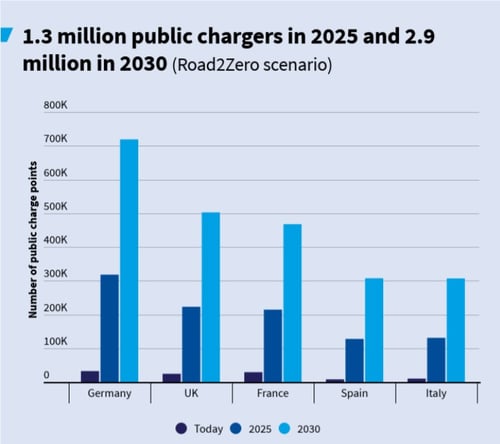
Source: Recharge EU: How many charge points will Europe and its member states need in the 2020's.
By 2025 the number of charge points in the EU will increase to 1.3 million, followed by 3 million in 2030. They are not messing around, and that is a good thing. From 2019 to 2020 the European Automobile Manufacturers Association noted an increase in the market share for ECVs of 211%.
More Chargers Mean More Interest…and Complexity
Obviously, more chargers are coming, and more electric cars are coming. Millions upon millions of people will need to rely on both to get on with their daily lives and make the commitment to go or stay green. For manufacturers, this should be a dream come true. The demand is already there, they simply need to meet it. Easy, right?
If only. Testing either element comes with its own set of challenges. They need to be exceedingly thorough to meet the quality requirements expected from a respected brand. They also need to be fast because the demand is now.
Testing the Charger
The handle of an EV charger is built with very thin, delicate components. They are easily breakable but need to be as thoroughly tested as the battery itself. And by the way, these thin and delicate components come in different form factors, depending on the continent they are built for. Additionally, they need to have the ability to manage major swings in voltage and current.
Testing the Battery
The EV battery is also no piece of cake. It works in 2 different modes to keep the vehicle operational. First is energy generation mode when the car is accelerating. The motor needs to generate energy and requests power from the battery system. The second mode is when the driver is decelerating or breaking. Here, the engine will try to transform the kinetic energy from the car back into electricity. This is energy recovering mode. Both need to work properly to keep that car going, increasing the complexity of test.
That being said, these are challenges worth undertaking. The impact that EVs will make on the climate are proven to be huge. The more reliable electric cars become, the sooner we can eliminate petrol fueled cars from the streets. Why wait?
Want to know more about the challenges facing EV test?
Download our webinar to hear from our experts!
Get in touch with our experts or navigate through our resource center.


