
Considerations and challenges in the integration of A.I. for better quality.
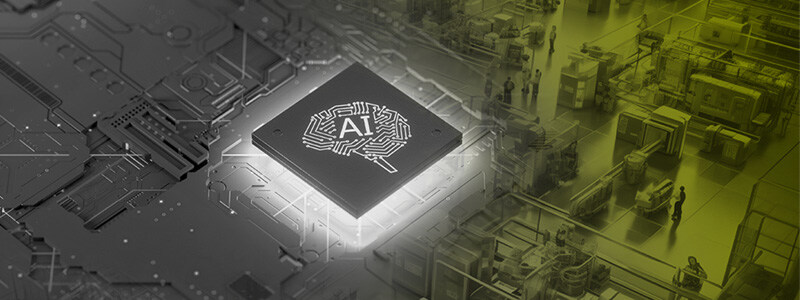
Artificial intelligence (A.I.) is one of the most future-oriented and promising innovations of our time. Companies are increasingly relying on A.I. to keep pace with technological progress because it offers a broad spectrum of applications. From analysis of process and logistics data, quality assurance and machine control to completely new digital, data-based business models, there are few limitations. The same holds true in the world of test, quality and visual inspection.
Definition of A.I.
Everyone is talking about A.I., but what exactly does it mean? The European Parliament explains:
“A.I. is the ability of a machine to display human-like capabilities such as reasoning, learning and planning and creativity. A.I. enables technical systems to perceive their environment, deal with what they perceive, solve problems and act to achieve a specific goal. The computer receives data – already prepared or gathered through its own sensors such as a camera – processes it and responds. A.I. systems are capable of adapting their behavior to a certain degree by analyzing the effects of previous actions and working autonomously.”
Integrating A.I. into Manufacturing
Navigating the integration of A.I. in manufacturing inspections requires a strategic approach. As companies embrace A.I.-powered inspections to optimize their operations and boost profitability, it's essential to understand the best practices and key considerations for deploying these technologies in manufacturing processes.
Capital Expenditure versus Operational Costs
A.I. can increase efficiency, improve accuracy and be cost-effective in many cases, but not all. It goes without saying that while A.I. offers interesting opportunities to companies of all sizes, it will often require higher levels of integration effort and upfront investment costs. The cost-benefit balance is often positive in the long term as long as the planning phase is done mindfully to avoid overkill. The trade-off is heavily dependent on the respective use case, equipment and test requirements. These can vary based on testing speed, volume of devices under test (DUTs), product and defect size, repeatability of results and traceability requirements.
Nowadays, there are many scenarios where automation and often A.I. have become unquestionable to future-proof smart factories. It is important to do an overall assessment to determine when an application is a good fit. These can include:
- DUTs with complex test parameters and a small time frame for testing.
- High volume of DUTs that need to be tested quickly and/or 24/7.
- DUTs with defects/features whose manual detection requires the same (optical) hardware as automated tests.
- Test characteristics that are not easily recognizable by humans.
- Tests that require 100% reproducibility of results at any time of the day and/or prohibit subjective assessment.
Automation and A.I. Integration
Once a company takes the decision for further automation and A.I. based on the cost-benefit analysis, integration becomes the next step. However, the shift to A.I. and human-like inspection technologies isn't a straightforward process. It demands substantial time, resources, and training investment. A carefully planned and well-documented release management program is also crucial to ensure a seamless technology transition. It's also worth noting that while A.I. can replicate human actions and decisions, up to now it cannot substitute the experience and expertise of a seasoned operator. Therefore, businesses need to find the right balance between utilizing A.I., the right mechatronics and human expertise for optimal results. In times of a shortage of skilled specialists, this may be the right moment to bring an experienced partner on board.
Promoting Better Quality Assurance
Quality assurance (QA) is an area where automated inspection systems are gaining momentum. These systems employ advanced technologies like spectroscopy, enabling the identification of defects invisible to the naked eye. The deployment of UV and infrared inspections can be an effective strategy to reveal hidden defects.
However, the design of these inspection systems necessitates a thoughtful examination of the imaging hardware. It's not just about capturing high-resolution images to detect defects; it's also about anticipating potential flaws that might surface during the product's lifecycle. While a higher resolution might escalate hardware costs, it can also affect operational expenses related to data processing and storage.
Mechanical Construction
Another vital factor in adopting A.I. and human-like inspection technologies is the consideration of mechanical construction and the motion system. This often-ignored component is crucial to the successful operation of the inspection system. An accurate motion system can minimize image variance, simplifying the training process for the A.I. algorithm. Additionally, the motion system selection largely depends on the product and defect size. For instance, identifying defects of several microns in size, like a needle tip, would necessitate a different motion system than detecting defects of several millimeters in size, like construction products.
Image Acquisition
The image acquisition system stands as a pivotal element in the design of a human-like inspection system. Various techniques can be employed to extract a wealth of information from images, surpassing what a human operator could discern. Techniques such as light search can be utilized to guarantee consistently sharp and focused images.
External elements like ambient light and vibrations can influence the efficiency of automated inspection systems. Though often controllable, these factors can present substantial challenges if overlooked during the early stages of design. For example, lab lighting can fluctuate throughout the day, affecting inspection outcomes. It is therefore essential to future-proof your equipment to adapt to your products' evolution.
Data Quality
Moreover, in a data-driven inspection system, data quality is of utmost importance. This necessitates accurate data labeling or defect catalog building. Implementing techniques such as multiple operators labeling identical data sets and comparing results for outliers can enhance your labeling quality. It is also recommended to develop a comprehensive labeling guide encompassing product attributes and specific instructions for managing ambiguous or edge cases. Consistency in the labeling process is vital, as is maintaining version control and overall label data quality. A balanced data set is also crucial, ensuring that infrequent defects are proportionately represented in the training sets for detection algorithms.
The Bottom Line
It's crucial to note that A.I. and traditional vision may not always offer the perfect solution to every problem. An in-depth evaluation of your products, coupled with the quality of your data and goal of the application can greatly influence the outcome. This emphasis extends to the handling and motion system, as well as the optical system.
On the other hand, understanding and harnessing the dual powers of A.I. and human-like inspection can revolutionize your manufacturing sector. However, an effective implementation strategy demands careful consideration, informed investment decisions, and a comprehensive understanding of the technologies involved. Embracing these factors can significantly enhance manufacturing processes, drive efficiency, propel profitability, and ultimately, strengthen your leading position in a highly competitive market.
For any questions on the integration of A.I. into manufacturing, please contact Averna.
You may also be interested in…
Not familiar with Best Practices for A.I. and human-like inspection? Download our webinar to get started!
Get in touch with our experts or navigate through our resource center.


