

Key Takeaways
- ► Commissioning validates every critical system under real-world conditions and turns assumptions into proven performance.
- ► From power and cooling to fiber optics, commissioning ensures seamless operation and compliance with global standards to avoid costly failures.
- ► Factory tests, site inspections, functional trials and integrated rehearsals confirm readiness before go-live.
- ► Downtime, SLA (Service Level Agreement) penalties, inefficiencies and insurance complications can result from weak or skipped commissioning.
- ► Comprehensive documentation, accurate records and traceable evidence simplify audits and support long-term operational stability.
Walking into a new data hall before sunrise, everything looks ready: cool air, quiet aisles, and rows of racks glowing with status LEDs. But looks can be deceiving. True readiness is only proven through rigorous testing and validation. Commissioning transforms a built installation into a verified facility aligned with standards such as ISO/IEC 22237 and EN 50600. It is a process of testing, measuring, and documenting performance under real-world conditions. Power systems must sustain load without hesitation. Cooling must respond to rapid changes without overshoot. Network links must deliver clean signals with margin, which is why telecom test and measurement practices are critical during commissioning; controls and alarms must report immediately.
Commissioning transforms uncertainty into confidence by validating every layer of the infrastructure under conditions that replicate real operations. The process begins long before tenants arrive and continues until the entire building has completed integrated rehearsals at full load.
What Is Data Center Commissioning?
Definition and Core Objectives
Data center commissioning is a structured process that verifies design intent, performance, and safety across all critical systems in compliance with ANSI/TIA-942 and Uptime Institute Tier guidelines. It moves through five levels, starting with factory tests and ending with full-facility trials under realistic conditions. Each stage builds confidence that the infrastructure will perform as designed.
Throughout the process, engineers gather time-stamped evidence, compare results to acceptance criteria, and record lessons for future operations.
Commissioning is not just a formality. It is a rigorous demonstration of reliability.
Unique requirements in data centers vs. traditional buildings
Unlike traditional buildings, data centers require extreme reliability under ASHRAE thermal and NFPA fire protection standards. Power must remain uninterrupted. Cooling must react instantly to thermal changes. Network links must maintain clean signals with margin. Monitoring systems must deliver accurate alarms without delay.
Commissioning validates these conditions under real-world scenarios. It ensures the facility can handle rapid changes without compromise.
The Five Levels of Data Center Commissioning
Commissioning progresses through five structured levels or stages. Each has a clear objective and produces documented proof.
Level 1: Factory Acceptance Testing (FAT)
Before shipment, every component must demonstrate compliance with design and safety standards such as ISO/IEC 22237 for electrical and environmental integrity. Engineers observe factory tests that confirm electrical performance, control logic, and firmware integrity. These checks ensure only fully validated equipment reaches the site.
Key actions at level 1:
- Check electrical performance under full operating range
- Confirm safety interlocks prevent hazardous conditions
- Validate control logic for alarms and recovery states
- Check firmware versions against approved bill of materials
- Review documentation for completeness and accuracy
- Execute scripted load tests to confirm stability
- Capture witness reports and formal sign-off for compliance
Level 2: Site Inspection, Installation, Pre-Commissioning
Once equipment arrives, teams verify installation quality and physical readiness. They inspect labeling, mechanical connections, and cabling. Fiber cleaning and inspection prevent signal issues before performing optical performance tests in line with ANSI/TIA-942 cabling requirements. This stage ensures the site is prepared for safe power-up.
Key actions at level 2:
- Match delivered parts and labels to design documentation
- Verify torque settings on electrical lugs for safety
- Inspect physical clearances for airflow and maintenance access
- Check cable routing and integrity against installation standards
- Clean and inspect fiber endfaces to prevent signal loss
- Apply initial power in controlled steps to confirm readiness
Level 3: Start-up & Pre-functional Testing
Subsystems are powered up in a controlled sequence to confirm basic functionality. Engineers monitor UPS (Uninterruptible Power Supply) stability, cooling performance, and alarm mapping. Logs capture all critical events for traceability. This level verifies that core systems respond as expected.
Key actions at level 3:
- Confirm UPS and inverter stability under live input
- Validate switchgear and PDUs (Power Distribution Unit) communicate with BMS (Building Management System) correctly
- Start CRAH (Computer Room Air Handler) and CRAC (Computer Room Air Conditioner) units and monitor for short cycling
- Map alarms to dashboards for accurate fault reporting
- Capture logs for breakers, valves, and sensors during energization
Level 4: Functional Performance Testing
The facility is tested under simulated operational stress. Load banks replicate real power demand while engineers introduce controlled faults. Using power and energy test solutions, they validate redundancy logic, monitor control loops, and confirm cooling efficiency under dynamic conditions as recommended by ASHRAE thermal guidelines.
Key actions at level 4:
- Deploy load banks to replicate real tenant power profiles
- Inject controlled faults to test failover response
- Validate redundancy logic under stress conditions
- Observe control loop stability during dynamic load changes
- Measure supply and return temperatures to confirm cooling efficiency
Level 5: Integrated Systems Testing (IST)
The final stage demonstrates complete system resilience. Engineers simulate utility outages, monitor generator start-up, and verify seamless power transfer. Cooling and network systems are tested for failover capability. All results are logged and measured against acceptance criteria.
Key actions at level 5:
- Simulate utility power loss and verify generator start sequence
- Test automatic transfer switch for seamless power transition
- Measure UPS ride-through time during outage events
- Monitor cooling system response to sudden load changes
- Validate network failover for uninterrupted connectivity
- Collect time-stamped logs and video for audit and compliance
Where Testing Actually Happens Inside a Data Center
Data centers are divided into functional zones. Each zone introduces specific testing conditions and risks that must be addressed during commissioning.
Entrance Room (ER)
The entrance room is where long fiber runs and splices converge. These links require bidirectional OTDR (Optical Time Domain Reflectometry) to pinpoint reflections and attenuation. Engineers also validate splice quality and ensure MPO connectors are clean and correctly polarized according to ANSI/TIA-942 specifications. Proper handling prevents signal inversion and early-life alarms that can compromise reliability.
Main Distribution Area (MDA)
The main distribution area houses high-density trunks and core switching equipment. Optical performance is critical in this zone, where MPO (Multi-fiber Push-On) connectors enable efficient multi-fiber connectivity for trunk cables. Engineers measure insertion loss budgets to confirm compliance with design criteria and verify path mapping for accurate connectivity between core components. Before any cross-connect goes live, circuits undergo thorough optical testing to guarantee signal integrity and prevent failures during early operation.
Horizontal & Intermediate Distribution Areas (HDA / IDA)
These areas combine copper and fiber cabling, creating unique challenges. Engineers test category cables for compliance with standards and check for alien crosstalk, which can degrade network reliability. Fiber links are validated for loss and polarity to ensure proper signal flow. In high-speed environments, Cat6A and Cat8 considerations are applied to maintain optimal transmission quality and avoid performance bottlenecks.
Equipment Distribution Area (EDA)
Located near the racks, the equipment distribution area demands precise validation of ToR (Top-of-Rack cabling and direct attach copper connections. Engineers test DAC (Direct Attach Cable) assemblies and confirm that transceiver optical power levels remain within expected ranges. These checks ensure SFP (Small Form-factor Pluggable) and QSFP (Quad Small Form-factor Pluggable) modules operate correctly, supporting stable connectivity for servers and network devices under full load conditions.
Best Practices for Reliable Commissioning
To ensure the process runs as smoothly as possible, the following best practices are recommended:
Early involvement of the commissioning authority
Engage commissioning experts early and combine their expertise with smart manufacturing solutions to streamline validation and reduce errors during design and construction workflows.
Early involvement of the commissioning authority
Engage commissioning experts early and combine their expertise with smart manufacturing solutions to streamline validation and reduce errors during design and construction workflows.
Documentation, tracking, and issue resolution
Move from scattered files to structured, traceable records. Use timestamps, photos, and video to simplify audits. Capture witness reports, sign-offs, and logs at every level.
Mechanical, electrical, and controls coordination
Test power and cooling systems under stress following EN 50600 and NFPA guidelines. Verify generator start-up, transfer switch operation, and UPS ride-through. Check battery health, voltage quality, and harmonics. Ensure monitoring systems display accurate names, ranges, and alarms. Tune control loops for quick and stable response.
Testing with real or simulated load
Heat load testing simulates real conditions. Arrange portable or rack-level load banks and automated test equipment to match expected power density. Monitor supply and return temperatures for stability. Observe airflow patterns and adjust for obstructions. Acceptance criteria include temperature windows, control stability, and recovery times.
Operator training and knowledge transfer
Commissioning ends with structured handover. Provide clean documentation, training, and baselines. Operators learn alarm interpretation, failover timing, and safe recovery procedures.
Common pitfalls and how to avoid them
The following table outlines common issues encountered in commissioning, why they occur, and how to prevent them.
| Pitfall | Root Cause | Avoidance |
Commissioning a Data Center: Is It Mandatory?
In most countries, commissioning is not legally required. However, it is considered best practice because it delivers confidence and long-term value. It ensures systems work under real conditions, speeds up acceptance, and builds trust with customers and partners. Benefits include optimized performance, fewer delays, and stronger credibility with insurers and investors.
The Hidden Cost of Poor Testing in Data Centers
Incomplete or poorly executed commissioning can lead to serious operational and financial consequences. Below are the most common and costly issues:
- Unplanned downtime and SLA penalties
Outages during live operations result in service credits, customer dissatisfaction, and reputational damage. - Equipment failures caused by missed issues in earlier commissioning levels
Components that were never properly tested can fail under load, creating cascading problems across systems. - Reduced redundancy performance (N, N+1, 2N not functioning as designed)
Backup systems may not activate correctly during faults, leaving critical infrastructure exposed. - Cooling inefficiencies that inflate OPEX
Poor airflow validation and control tuning lead to higher energy consumption and increased operational costs. - Emergency systems that fail under real conditions
Fire suppression, alarms, and failover mechanisms may not respond as intended, compromising safety and uptime. - Warranty and insurance complications
Lack of documented commissioning can void warranties and make insurance coverage difficult or expensive. - Increased carbon footprint from inefficient operation
Systems running outside optimal parameters consume more energy, undermining sustainability goals. - Reputational and financial impact during outages
Service interruptions damage customer trust and can result in significant financial losses.
What Strong Commissioning Delivers Compared to Weak Testing
- Uptime and SLA performance
Strong commissioning identifies faults early and validates failover through rehearsals, ensuring resilience under load. Weak or rushed testing turns first live traffic into the test bed, leading to outages, SLA penalties, and reputational damage. - Cost of delivery
Comprehensive testing reduces change orders, accelerates acceptance, and prevents costly rework. Poor testing causes construction delays, missed acceptance windows, and inflated project costs. - Insurance and financing
Documented commissioning improves insurability and builds confidence with lenders and investors. Without it, readiness remains unclear, increasing perceived risk and limiting financing flexibility. - Operations handover
Strong commissioning provides complete documentation, training, and baselines for smooth operations and future upgrades. Weak testing leaves gaps that slow troubleshooting and increase effort for changes. - Energy efficiency and sustainability
Proper tuning during commissioning optimizes performance, reducing energy use and carbon footprint. Poor testing results in inefficient operation and higher environmental impact. - Customer trust and reputation
Proven reliability strengthens brand credibility and customer confidence. Frequent issues erode trust and damage long-term relationships.
Emerging Trends in Data Center Commissioning
Expanded level frameworks: from Level 0 to Level 7
Expanded frameworks add stages before and after the standard five levels.
- Level 0 introduces early design validation before construction.
- Levels 6 and 7 focus on post-handover optimization and continuous improvement.
Depending on the approach, the framework can include:
- Levels 0–5 (six levels total) when only design validation is added.
- Levels 0–6 and Levels 0–7 (seven or eight levels total) when optimization stages are included.
This flexibility allows organizations to tailor commissioning to their lifecycle goals.
Digital commissioning tools and automation
Digital technology is making commissioning smarter and faster. Robotic integration services automate testing and equipment handling for greater precision. Real-time analytics turn checks into instant insights, while digital twins let teams simulate scenarios before physical trials, reducing risk and saving time.
Sustainability becomes measurable. Efficiency targets are validated during heat load runs and tracked for ongoing optimization. Automated documentation captures timestamps, photos, and video in one system, making audits quick and effortless.
Your Data Center Deserves a Commissioning Process that Matches its Criticality
A data center without rigorous testing is a risk waiting to happen. Comprehensive commissioning ensures that every component works together seamlessly under stress, protecting uptime and operational integrity. It verifies redundancy, optimizes efficiency, and provides documented evidence for insurers and investors. Averna brings deep expertise and proven processes to transform complex environments into predictable, high-performance facilities.
Our engineers work in complex environments where uncertainty is not an option. If you want to minimize risk and be sure your infrastructure performs exactly as intended, talk to our experts and let Averna guide you through a comprehensive commissioning and testing review.
Author: Regis Sayer
Engineering Sales Director (CSA)

You may also be interested in…
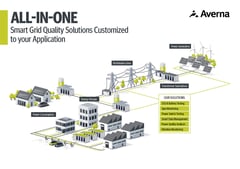
From power monitoring to distribution, Averna has an all-in-one solution to cover the entire grid. Get the details!
Get in touch with our experts or navigate through our resource center.


