
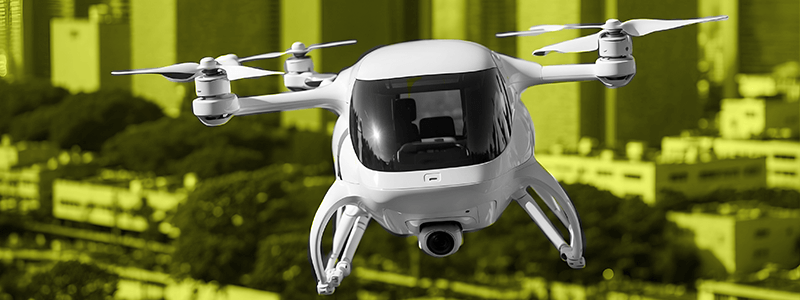
The eVTOL industry is going through a unique moment. Functional aircraft exist, billions of dollars in orders have been signed, and yet none of them are carrying paying passengers in the United States.
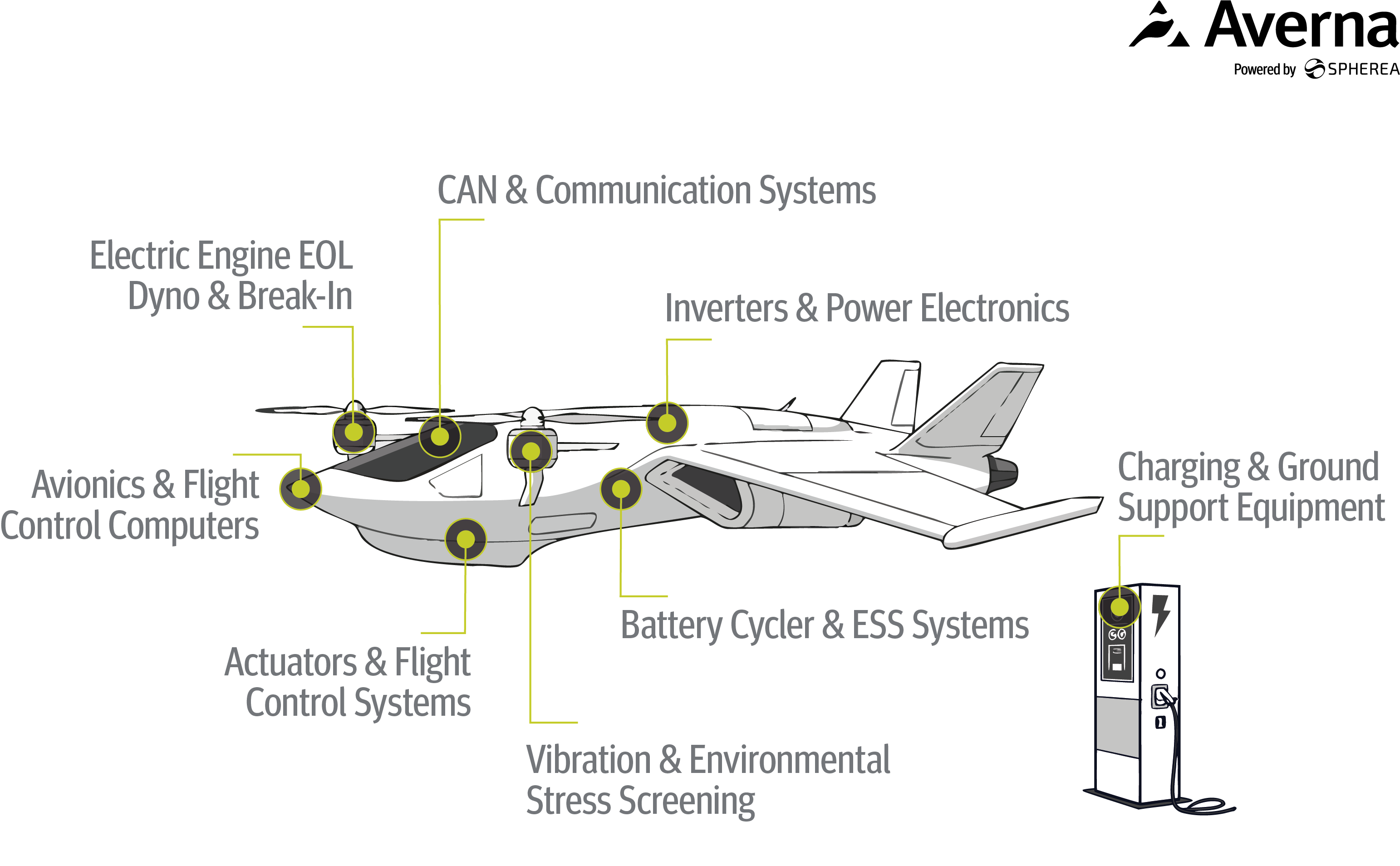
This guide explains what eVTOLs are, how they work, the design choices behind them, how they compare to helicopters, who currently dominates the market, and why testing has become the real bottleneck on the path to commercial flight. Averna Powered by Spherea develops the comprehensive eVTOL testing solutions required to bridge this gap; the technical perspective of engineering is therefore present throughout this article.
Key Takeaways:
- eVTOL stands for Electric Vertical Take-Off and Landing.
- Four main design families dominate the market: multirotor, lift-plus-cruise, tiltrotor, and vectored thrust.
- The hard part is no longer flying. It is proving, under still-maturing certification frameworks, that an electric aircraft will fly safely thousands of times over.
What Is an eVTOL? Definition
An eVTOL is an electrically powered aircraft that takes off and lands vertically, without a runway. The acronym stands for Electric Vertical Take-Off and Landing. It brings together two concepts: vertical flight, historically associated with helicopters, and electric propulsion, driven by the same technological advances found in automotive motors and power electronics.
The key difference from a conventional VTOL aircraft lies in the energy source. A Harrier fighter jet can take off vertically, but it burns aviation fuel. An eVTOL generates that same vertical thrust using electric motors driving rotors, propellers, or ducted fans.
In the United States, most current concepts fall under the broader regulatory category of Advanced Air Mobility (AAM), and many are intended for Urban Air Mobility (UAM), these short city-center to city-center or city-to-airport routes often described as air taxi services.
An eVTOL can be piloted onboard, remotely operated, or, in the longer term, fully autonomous. Configurations vary widely, but the core characteristics remain the same: electric power and vertical thrust.
Today, it is the promise of autonomous flight that is the clear distinction that towards the expected success of eVTOL vs VTOL. It is widely believed that without this, the industry won’t take flight.
How Does an eVTOL Work?
An eVTOL operates by converting stored electrical energy into thrust using electric motors. It uses this thrust for vertical lift during takeoff and landing, then transitions to more efficient horizontal flight for the cruise phase. Four subsystems make this possible.
1. Electric Propulsion
At the core of the aircraft is the electric propulsion system: a battery pack, electric motors, and the power electronics that distribute energy between them. Compared to an internal combustion engine, electric propulsion is quieter. It also produces no direct emissions and allows thrust to be distributed across multiple smaller motors rather than relying on a single large engine.
This last point is particularly noteworthy: distributing propulsion across several independent units (distributed electric propulsion) means that the failure of one motor does not cause the aircraft to fall, something single-engine helicopters cannot offer.
The ideal propulsion system for short-range air mobility remains an open engineering question. Fully battery-electric architectures dominate today because they are simpler and cleaner, but their range is limited by battery energy density.
Hybrid-electric and hydrogen fuel cell approaches are being explored to extend range on regional routes. The right solution depends on the mission: an urban air taxi will not have the same optimization criteria as a regional transport aircraft.
2. Batteries and Energy
Energy density is the main constraint driving nearly every design decision in an eVTOL. A battery that stores more energy per kilogram enables greater range, higher payload, or both. Most current aircraft use lithium-ion chemistries, with solid-state batteries widely seen as the next technological step.
Until energy density improves significantly, engineers will have to balance range, passenger count, and safety reserve margins. This trade-off defines what each aircraft can realistically achieve.
3. Vertical Lift and the Transition
Vertical lift is generated by rotors or fans directed downward during takeoff and landing.
But the truly complex phase is the transition: the shift from vertical lift to horizontal cruise flight. Depending on the configuration, this is achieved by tilting the rotors, tilting the entire wing, or transferring lift from dedicated vertical rotors to separate cruise propellers. The transition is aerodynamically complex; it is one of the most rigorously tested flight regimes in any eVTOL program, as it is the moment when everything changes simultaneously.
4. Avionics and Flight Control
Distributed propulsion only works if software coordinates each motor in real time. eVTOL flight control systems continuously adjust thrust across all propulsion units to maintain aircraft stability, especially during hover and transition phases.
Many designs incorporate advanced avionics and varying levels of automation, with full autonomy remaining a longer-term objective that depends as much on regulation as on technological progress.
eVTOL Design: The Four Main Configurations
eVTOL design comes down to one central compromise: hovering efficiently and cruising efficiently demand opposite things. An aircraft optimized to hover wastes energy in forward flight, and a wing optimized for cruise struggles to hover. Each configuration resolves that tension differently.
- Multirotor designs suit short urban trips and resemble large-scale drones.
- Lift-plus-cruise configurations add a wing and dedicated cruise propellers to improve range.
- Tiltrotor or tiltwing aircraft aim to combine the benefits of both approaches, at the cost of increased complexity.
- Vectored thrust distributes steerable propulsion along a fixed wing.
No single configuration has yet emerged as the standard. The industry is still in a phase of experimentation to determine which trade-off will be rewarded by economic viability and regulatory approval.
|
Configuration |
How It Works |
Strengths |
Trade-offs |
|
Multirotor |
Multiple fixed rotors provide lift and thrust, like a large drone |
Stable, easy to control |
Short range, lower speed |
|
Lift + Cruise |
Separate rotors for vertical lift and fixed propellers for forward flight |
Efficient cruise, mechanically simpler than tilting |
Carries dead weight (unused rotors) in each phase |
|
Tiltrotor / Tiltwing |
Rotors or the entire wing tilt to switch between lift and cruise |
High speed, long range |
Mechanically complex, harder to certify |
|
Vectored Thrust |
Fixed wings with rotors or fans that vector thrust for both lift and cruise |
Efficient cruise, strong maneuverability |
Complex thrust management |
What Are eVTOLs Made Of? Key Materials
eVTOL materials are chosen to do one thing above all: save weight. Every kilogram of structure is a kilogram that cannot be battery or payload. On an aircraft constrained by battery energy density, weight discipline is survival!
Airframes lean heavily on carbon-fiber composites, which deliver high strength at a fraction of the weight of aluminum. The propulsion system, on the other hand, depends on high-performance permanent-magnet motors, power-dense electronics for inverters and converters, and the battery cells themselves, where chemistry and packaging directly determine range. Thermal management materials matter more than most people expect, because both batteries and power electronics generate heat that must be moved away efficiently to maintain performance and safety.
The materials story and the energy story are the same story. Lighter structures and denser batteries are the two levers that decide whether an eVTOL can do useful work, and nearly every materials decision traces back to that equation.
eVTOL vs Helicopters: How do they Compare?
People often ask whether eVTOLs are better than helicopters, but the most honest answer is that they excel in some areas and are still being evaluated in others. Both can take off vertically, so the comparison is fair, but in reality, they address different problems.
|
Aspect |
Helicopter |
eVTOL |
|
Propulsion |
Combustion engine, single main rotor |
Electric motors, distributed rotors |
|
Noise |
High |
Substantially lower |
|
Emissions |
Direct CO2 and pollutants |
Zero direct emissions (battery-electric) |
|
Redundancy |
Limited; single rotor is a single point of failure |
Multiple motors allow safe operation if one fails |
|
Range |
Long, refuels quickly |
Limited by battery energy density |
|
Operating cost |
High maintenance, fuel-dependent |
Lower projected maintenance, fewer moving parts |
|
Maturity |
Decades of certified service |
Pre-commercial in most markets |
Where eVTOLs clearly stand out is in terms of noise, emissions, and propulsion redundancy. Distributing lift across multiple motors eliminates the single point of failure that defines much of the risk associated with helicopters.
However, helicopters still have the edge in range and in the simple fact that they are already certified and operating on a daily basis. The advantage of eVTOLs is real but remains largely prospective: it depends on continued improvements in battery technology and on achieving certification milestones that have not yet all been validated. Luckily, that’s where we come in to help!
A Short History: The First VTOL and eVTOL Aircraft
Vertical flight predates electric propulsion by a wide margin. Experimental VTOL aircraft such as the jet-powered Hawker Siddeley Harrier demonstrated as early as the 1960s that an aircraft could take off vertically without a runway, although it relied on thermal energy.
The electric chapter is much more recent. The modern eVTOL movement gained momentum during the 2010s, when advances across key components finally made electric vertical flight viable. This shift coincided with growing demand for quieter and cleaner urban transportation.
Early pioneers such as NASA with its Puffin concept in 2009, AgustaWestland with its Project Zero technology demonstrator in 2011, followed quickly by startups like Joby Aviation and Volocopter, began developing prototypes. They paved the way for the many manufacturers and aerospace giants competing in the market today.
Who Is Leading the eVTOL Industry?
No company has officially “won” the race yet, as victory means certified commercial passenger operations, and no one has crossed that finish line in Western markets. A leading group has nevertheless clearly emerged. In the United States, two names dominate most conversations, followed by a strong cohort of international players.
Given how FAST this industry is moving, these figures come with a big disclaimer: we’re writing this in June 2026!
Joby Aviation (USA): Widely considered the manufacturer closest to certification in the United States. Its S4 aircraft uses a tilt-rotor architecture. Designed to carry one pilot and four passengers at speeds of up to 200 mph (around 320 km/h) over a maximum range of 150 miles (240 km), Joby is actively pursuing FAA type certification, backed by significant financial support from Toyota. The company is also preparing commercial launches in Dubai.
Archer Aviation (USA): The other major U.S. leader is developing the Midnight, a vectored-thrust aircraft (12 rotors on a fixed wing) designed for short urban trips of around 20 to 50 miles, with a maximum range of up to 100 miles. Archer relies on major industrial partnerships with Stellantis for mass production and United Airlines for route operations, and benefits from a strong financial position.
And for international players:
-
EHang (China): The only company in the world to have broken the commercial stalemate. Its fully autonomous multirotor model (with no pilot onboard) has received type certification from the CAAC in China and is already operating tourism and light commercial flights in certain regions.
-
Volocopter (Germany): Focused on a pure multirotor design for short urban hops.
-
Lilium (Germany): Developing a unique concept of electric jets using ducted vectored thrust for regional, intercity routes.
-
Eve Air Mobility (Brazil): A subsidiary of aerospace giant Embraer, benefiting from a massive order book and long-standing industrial expertise.
-
Vertical Aerospace (United Kingdom): Continuing the development of its aircraft despite the inherent challenges of prototype testing.
What is the Fastest eVTOL?
Among market leaders, announced target top speeds generally range between 150 and 200 mph (240 to 320 km/h) for winged models (such as Joby or Lilium), while multirotor architectures typically top out below 130 km/h.
Maximum speed is intrinsically tied to the aircraft’s architectural configuration: tiltrotor and vectored-thrust designs fly significantly faster than pure multirotor concepts. This is because, in cruise flight, a fixed wing generates the aircraft’s aerodynamic lift, allowing the motors to devote their full power to horizontal speed.
Why Testing is the Real Path to Certification
While media attention often focuses on the aircraft that flies the fastest or raises the most capital, the real constraint facing the eVTOL industry is verification. Building an aircraft capable of flying once is an engineering achievement; proving that it will fly safely over thousands of flights, under degraded conditions, with redundant systems responding exactly as expected, is what separates a clever prototype from a certified product.
This proof is more difficult to establish for eVTOLs than for conventional aircraft, for two main reasons:
-
Regulatory frameworks are still being defined. Programs are progressing within evolving structures, such as EASA’s SC-VTOL regulation in Europe or the FAA’s Special Class certification under 14 CFR §21.17(b) in the United States. Requirements are tailored on a case-by-case basis rather than drawn from decades of established aeronautical precedent.
-
eVTOLs sit at the intersection of two demanding technological domains. They combine safety-critical aeronautical systems with high-voltage electric propulsion. Each of these areas brings its own validation burden. The battery, inverters, motor distribution, flight control software, and actuators must each be validated individually, and then as a fully integrated system.
This is where test infrastructure becomes a strategic decision rather than just a budget line. The testing tools developed early in a program must remain relevant through final qualification and into production, adapting as specifications evolve.
Hardware-in-the-loop (HIL) testing and system-level validation allow teams to detect issues while they are still relatively inexpensive to fix, rather than during real flight tests, where every change becomes exponentially slower and more costly. In an industry that invests heavily for years before generating its first revenue, the efficiency of this validation process is directly tied to survival.
Averna Powered by Spherea is Ahead in eVTOL Testing
Averna develops eVTOL test platforms that span the full development cycle, from rapid embedded prototyping through end-of-line production testing. The approach draws on years of work in aerospace and defense critical systems and electrified powertrain validation, the same two domains eVTOL programs must master. If you are building toward certification and want your test strategy to keep pace with your program, our eVTOL test engineers can help you map it out.
You may also be interested in…

What does it take to make eFlight possible and what is coming up next in the aerospace industry? Find out more in this whitepaper.


