

Key Takeaways
► A Proof of Concept (POC) is known from product design, but in automated test engineering it confirms that a test idea works on real hardware.► A POC defines clearer requirements because it confirms real measurement and automation behavior early.
► A strong POC reduces technical risk and gives managers confidence in architecture and planning.
► A POC focuses on the most critical technical question before broader prototype or pilot evaluations begin.
► A POC verifies that the automation approach can communicate with instruments, meet timing needs, and operate safely.
In test engineering, real progress begins when ideas leave the meeting room and land on the bench. A POC (also referred to as a feasibility study) in test engineering is where theory meets hardware and reality decides what happens next. You connect instruments, route signals, power up the device under test (DUT), and quickly learn whether accuracy, timing, and automation behave as expected under real conditions.
What’s a Proof-of-Concept (POC)?
A POC validates a technical hypothesis, a test architecture, a measurement protocol, or an automation strategy. It provides the foundation for the entire system by eliminating early uncertainties, aligning expectations, and producing documentation that captures all test requirements, system requirements, and automation needs in a clear and traceable way. When the requirements are understood from the start, the design and validation phases become far more efficient and predictable.
You can think of a POC as a small but decisive trial run. It strips away assumptions and reveals what is actually possible. It tells you what works, what needs refinement, and what risks should be addressed before the project grows larger. In other words, a POC replaces guesswork with evidence.
What Makes a POC Different from a Prototype or Pilot Bench?
In test engineering, terminology must be precise because expectations and budget decisions rely on it.
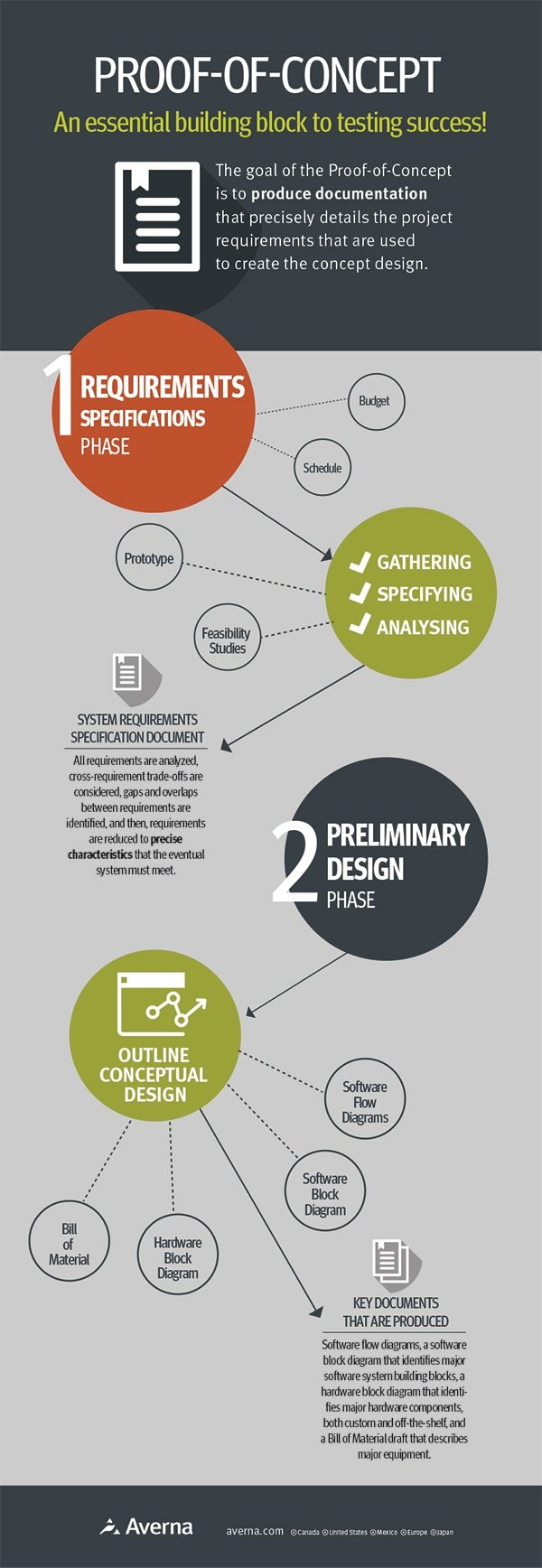
- POC: A POC is the smallest focused experiment that proves whether one critical test concept, measurement method, or automation idea will work in the real world. It is a fast stress test on a single part of the concept before you commit to anything larger. It often includes the Requirements Specifications stage and the Preliminary Design stage, which together provide the analytical and architectural backbone for the project.
- Prototype bench: A prototype bench is an early working setup that lets you try workflows and see how hardware and software behave together. It is where the overall concept starts to take shape, but it is not ready for production work.
- Pilot test bench: A pilot bench is a near final system used to confirm reliability, cycle time, and operational behavior under realistic conditions. It shows whether the design can handle everyday use before deployment.
Understanding these distinctions ensures technical goals stay realistic, and helps everyone involved know exactly what success should look like at each stage.
Why Test Engineering Projects Need a Proof-of-Concept
Many of the biggest risks in automated test systems and measurement architectures appear long before the first real fixture is built. They hide in assumptions about DUT behavior, measurement performance, timing, throughput, and integration. A POC shines a light on these blind spots.
A key strength of a POC is the Requirements Specification stage. This is where teams gather and analyze system level requirements, identify trade offs, remove overlaps, and refine them into precise characteristics the system must meet. Sometimes this requires engineering prototypes or feasibility tests to validate critical assumptions. The resulting System Requirements Specification document becomes a powerful contract of understanding between engineering teams and product developers.
A well-targeted POC in test engineering helps you:
- Validate new or demanding measurement techniques
- Verify stable communication between instruments, sensors, motion systems, and safety circuits
- Confirm that the architecture can scale to production volumes
- Gather real datasets that guide requirement refinement
- Identify hidden risks before they become costly surprises
A strong POC also creates a foundation. It delivers reusable code modules, validated hardware choices, and documented insights that shape the design phase.
The POC Process in Test Engineering
Typically, one would start small, determine and test what matters, adjust along the way, and finish with a clear direction for the design ahead. It keeps the process focused, practical, and surprisingly smooth.
Step 1: Define Requirements and Success Criteria
You start by identifying the most uncertain areas. This might include accuracy, noise levels, timing constraints, RF sensitivity, thermal drift, or unpredictable DUT behavior. You define measurable success criteria, so the outcome is clear and objective. This mirrors the Requirements Specification stage, where requirements are collected, analyzed, and documented so the project is built on a solid, mutually understood foundation.
Step 2: Design the Concept for the Test System
A POC is not about building a full bench. It is about creating the minimal setup that can expose the truth. This usually means:
- Essential instruments and sensors
- Only the required I/Os or motion hardware
- A simplified automation sequence
- DUT samples or simulated inputs
If a component does not contribute to the core question, it stays out of the POC.
Step 3: Build and Execute the POC Setup
This is the hands-on phase. You connect cables, adjust optics, switch RF paths, run scripts, and capture data. You observe how the DUT behaves under real conditions. You look for stability, repeatability, integration challenges, and unexpected responses.
Step 4: Analyze Results and Refine the Concept
The bench becomes the teacher. Based on what you observe, you may need to:
- Improve filtering or analysis
- Adjust timing or reduce latency
- Select better performing instruments
- Modify sequencing or motion control
- Identify integration or safety risks
These refinements help shape the design direction.
Step 5: Transition to Preliminary Design
A successful POC naturally becomes the foundation for the next phase. It leaves behind:
- A validated architecture
- A list of key system components validated in the POC
- A clearer automation strategy
- More accurate time and cost estimates
A strong POC does more than confirm an idea. It creates clear documentation and reusable insights that make the Preliminary Design phase faster and more accurate. The team can move forward with real data instead of assumptions.
During Preliminary Design, these results grow into complete block diagrams, workflow descriptions, and draft bills of materials. With fewer unknowns, estimates improve, risks drop, and decisions are based on evidence.
This is the real benefit: A documented POC that others can understand and reuse is far more valuable than a quick demo that leaves no trace.
Proof-of-Concept in Automation Testing
An automation POC answers an important question: Can the chosen software framework reliably control real hardware, manage instrument communication, and support the intended architecture of the automated test solution?
To find out, you evaluate:
- Compatibility with LabVIEW, TestStand, Python, .NET, or custom frameworks
- Stability of instrument communication
- Fixture I/O integration
- Logging and report structures
- Sequence flow including parallel execution
Automation POCs are real world exercises. They must handle timing constraints, safety conditions, and unpredictable device responses. Unlike traditional QA automation POCs that simply compare web testing tools or continuous integration (CI) integrations, an automation POC in test engineering must work directly with real I/Os, physical devices, timing constraints, and safety requirements.
Proof-of-Concept in Performance Testing
When a test solution must operate at high speed, low latency, or strict timing precision, performance cannot be guessed. A performance oriented POC verifies whether the system can deliver the required throughput and timing precision before the design is finalized.
These POCs validate:
- Cycle time potential
- Real time behavior under load
- Jitter and latency
- Signal processing capability
- Responsiveness of hardware-in-the-loop (HIL) setups
Catching performance issues early prevents expensive redesigns and schedule delays.
What a Good POC Delivers in Test Engineering
A well executed POC in test engineering gives you:
- Proven measurement concepts and sample datasets
- An early automation architecture
- Verified instrument control
- A refined requirement set
- A risk matrix based on real observations
- Architecture sketches and early bill of materials
- More accurate schedules and cost projections
- Documentation ready for the design phase
Involving users throughout the POC stages is very important. Their input often reveals missing use cases or operational constraints that the test station must address. When users feel involved from day one, they usually end up loving the POC because it results in successful projects.
Common Mistakes that make POCs Fail
- The scope grows too large
- Success criteria is vague
- Documentation is incomplete
- The setup becomes over-engineered
- The next steps are unclear
A POC must stay disciplined, focused, and traceable.
Ready to Validate Your Test Strategy?
If you are planning a new test platform for RF systems, medical device testing, EV components or high speed connectivity, a well targeted POC can prevent months of rework on the full test system. Averna’s test engineering experts can help you validate your strategy, reduce risk, and accelerate your path to a fully verified system.
Contact Averna to explore how we can accelerate your next test initiative and reduce the risks associated with high-stakes measurement challenges.
--

You may also be interested in...

Take the next step in your test strategy! Discover how Averna’s Prototyping and Consulting Services help you validate concepts, refine architectures, and accelerate development with expert support.
Get in touch with our experts or navigate through our resource center.


