
Global primary energy consumption has grown by nearly 97% since 1985 — from 94,000 TWh to over 186,000 TWh in 2024*. You may be reading this on a smartphone that is charging, in a lit room, with a television on in the background and a microwave running its third cycle of the evening. That is before accounting for the data center processing your search query, or the AI that helped surface this page.
Energy demand has never been higher, and it is not slowing down. The infrastructure built to supply that energy was not designed for this scale, nor for the volatility that comes with it.
Energy storage systems exist precisely to bridge that gap, and as the world pushes further into renewable generation and electrification, they are becoming less of a nice-to-have and more of a foundational piece of modern infrastructure.
Key Takeaways:
- Energy storage directly reduces utility bills by shaving peak demand charges.
- Time-shifting lets operators store energy when generation is cheap and dispatch it when demand peaks.
- Battery energy storage systems (BESS) have become the dominant solution for most new deployments.
What is an Energy Storage System?
An energy storage system is any technology that captures energy in one form, holds it, and releases it later as electricity or another usable form of power.
The need for storage comes from a fundamental mismatch. Most energy sources produce power on their own schedule: solar at noon, wind at 2 a.m., nuclear at a constant flat output. But demand follows a different pattern entirely. Without storage, grid operators must either curtail renewable output or accept instability.
Storage solves this by decoupling the moment of generation from the moment of consumption, absorbing excess energy when supply exceeds demand and releasing it when the balance tips the other way. This function is called time-shifting, and it is the foundation of everything else an ESS enables.
Types of Energy Storage Systems
The main types of energy storage systems are:
- Battery Energy Storage Systems (BESS)>
- Pumped Hydro Storage (PHS)
- Compressed Air Energy Storage (CAES)
- Flywheel Energy Storage
- Thermal Energy Storage
Each technology has its own set of trade-offs in terms of response time, energy capacity, cycle life, and deployment constraints. Let’s break down how each one works.
Battery Energy Storage Systems (Electrochemical)
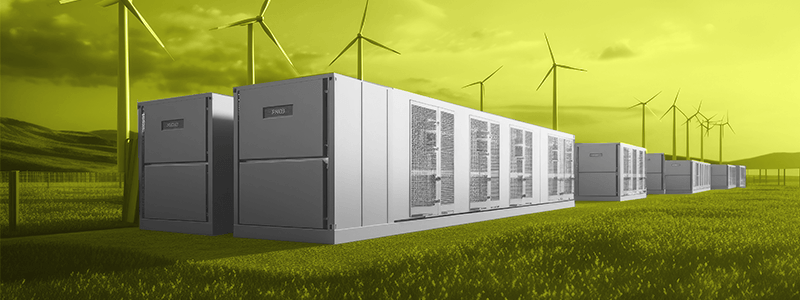
In practice, as battery costs have fallen and deployments have accelerated, the term 'energy storage system' is increasingly used to refer specifically to a battery energy storage system (BESS). This is an assembly of battery cells, power conversion equipment, a battery management system (BMS), and thermal and safety controls, packaged for grid-scale or industrial use.
The key components of a modern BESS are:
- Battery modules, most commonly lithium-ion (lithium iron phosphate chemistry dominates grid applications due to its thermal stability and cycle life)
- A battery management system (BMS) that monitors cell voltage, temperature, and state of charge, and protects against overcharge and over-discharge
- Power conversion electronics, including inverters that translate DC from the batteries to AC for the grid
- Thermal management systems, typically active cooling
- Energy management software that decides when to charge, when to discharge, and how to optimize the asset over time
- A simplified interface to connect to the grid and monitoring systems, for seamless integration into existing energy infrastructures
The system operates as a single controllable unit from the perspective of a grid operator or facility manager, even though it may contain thousands of individual cells.
Pumped Hydro Storage (PHS)
Pumped hydro is the oldest and most widely deployed form of grid-scale storage. During off-peak hours, excess electricity pumps water from a lower reservoir to an upper one. When demand rises, the water flows back down through turbines to generate power.
It is slow to respond compared to a BESS, but capable of storing enormous amounts of energy over long durations, making it the technology of choice for seasonal or multi-day balancing where geography permits.
Compressed Air Energy Storage (CAES)
CAES systems use surplus electricity to compress air into underground caverns or pressure vessels. When power is needed, the compressed air is released through turbines to generate electricity. Like pumped hydro, CAES suits long-duration, large-scale applications, but its geographic constraints (suitable geology is not universally available) limit widespread deployment.
Flywheel Energy Storage
Flywheels store energy as rotational kinetic energy in a spinning mass. They charge by accelerating the rotor and discharge by using that rotation to drive a generator. Response times are extremely fast but energy capacity is limited.
Flywheels are best suited for short-duration, high-power applications such as smoothing rapid frequency fluctuations or bridging the gap during a grid disturbance until slower resources come online.
Thermal Energy Storage
Thermal storage captures energy as heat or cold rather than electricity and releases it later to generate power or reduce electrical demand. Molten salt systems used in concentrated solar power plants are a well-established example: excess solar energy heats the salt during the day, and the stored heat drives a steam turbine after sunset. On the demand side, ice storage systems in commercial buildings shift air conditioning load away from peak hours by making ice overnight.
How Does a Battery Energy Storage System Work?
During charging, the power conversion system draws electricity from the grid or a generation source and uses it to drive electrochemical reactions inside the battery cells, storing energy in chemical form. During discharge, those reactions run in reverse, releasing electrons as electrical current, which the inverter converts to grid-compatible AC power, a process that depends on reliable bi-directional power transfer between the battery stack and the grid.
The battery management system runs continuously through both modes, balancing cells to prevent any single cell from running hotter or discharging faster than its neighbors. Cell imbalance is one of the primary causes of premature degradation in large battery packs, which is why BMS sophistication matters at scale.
Modern BESS installations can switch between charge and discharge in milliseconds. And this is not a theoretical capability, it is what makes them useful for frequency regulation, where the grid requires near-instantaneous response to keep AC frequency within a narrow band.
What are the Applications of Energy Storage Systems?
Energy storage systems serve a broad range of purposes in practice:
| Stabilizing grid frequency | Reducing peak demand costs |
| Integrating variable renewable generation | Enabling energy arbitrage between low and high-price periods |
| Providing backup power during outages |
Grid stabilization and renewable integration: At grid scale, BESS handles frequency regulation and peak shaving, while pumped hydro covers long-duration balancing over hours or days. Both functions are increasingly coordinated through smart grid infrastructure. A solar farm paired with a BESS can deliver power after sunset, a combination that changes the economics of solar significantly.
Commercial and industrial facilities: BESS manages demand charges by shaving the 15-minute peak that drives a large portion of utility bills. Thermal storage shifts HVAC load to off-peak hours, making ice overnight and using it for cooling during the day.
Electric vehicle infrastructure: In electric vehicle infrastructure, storage buffers the impact of fast chargers on the local grid. A 350 kW DC fast charger drawing directly from a weak distribution circuit creates problems. A BESS absorbs power slowly from the grid and delivers it rapidly to the vehicle, smoothing the load profile.
Microgrids and backup power: BESS provides sustained backup power for islanded operation, while flywheels handle millisecond-level bridging during grid transitions. Hospitals, data centers, and remote communities rely on this combination to maintain continuity when the main grid fails.
Residential: Home battery systems paired with rooftop solar panels allow households to self-consume their own generation rather than exporting at low rates and buying back at peak prices.
BESS appears a lot in this list, we know. There is a reason for that: it has become the Swiss Army knife of energy storage.
What are the Advantages of Energy Storage Systems?
Energy storage systems deliver value across four areas that matter directly to industrial operators and grid managers.
Lower energy costs: Storage lets facilities buy and hold cheap off-peak power for use during peak tariff periods. This also cuts demand charges by shaving the single 15-minute consumption peak that drives a large portion of industrial utility bills. For facilities on commercial or industrial tariffs, the demand charge lever alone can justify the capital investment within a few years, depending on local tariff structures and utilization patterns.
Operational continuity: A well-designed ESS acts as immediate backup power during grid disturbances and stabilizes voltage and frequency at the facility level, reducing wear on sensitive equipment and keeping critical operations running. It bridges the gap between a grid disturbance and generator startup, the window where unplanned downtime carries its highest cost.
Greater return on renewable assets: For facilities with on-site solar or wind, storage captures surplus generation for self-consumption rather than exporting it to the grid at low rates and buying it back at peak prices, improving the ROI of the renewable installation directly.
Grid-level reliability: At grid scale, a BESS responds in well under one second, fast enough to meet NERC and ENTSO-E primary frequency response requirements, reducing curtailment and lowering dependence on carbon-emitting peaker plants on standby. This directly supports electrification and sustainability goals.
Testing Energy Storage Systems
Energy storage system testing is at the core of what Averna does, and the stakes make clear why it demands specialist expertise. An ESS that fails in the field does not just go offline: it can overheat, vent gas, or in serious cases, enter thermal runaway.
Testing covers the full lifecycle of the system. At the cell and module level, manufacturers validate electrochemical performance, capacity, internal resistance, and thermal behavior across temperature ranges and charge/discharge cycles. At the system level, integration testing confirms that the BMS, inverter, thermal management, and communications all function correctly as an assembly.
For grid-connected systems, compliance testing against standards such as IEC 62619, UL 9540, and relevant grid codes is required before deployment. These tests cover safety, interoperability, and performance under abnormal conditions including short circuit, overcharge, and forced thermal abuse.
Functional safety testing verifies that protection systems (the BMS disconnect, fire suppression, ventilation) activate correctly when they are supposed to. This is not an area where teams rely on simulation alone. Averna's battery testing and EV battery testing experience spans this full range, from cell-level characterization to system-level validation under real operating conditions.
A Concrete ESS Testing Example
To illustrate this in a more tangible way, it helps to look at what we have already done. At Averna, we have been brought into test energy‑related systems long before they ever reach the field. One example comes from a project with ZF Wind Power. The challenge was to validate critical components exposed to intense mechanical stress and fluctuating energy loads.
 We built a test environment that could replicate real operating conditions, apply energy in both directions, and observe how the system behaved over time. The same philosophy applies to energy storage systems. You need to see how they react under load, how heat builds up, how performance drifts, and how reliable the data remains from one test cycle to the next. Our role was not just to verify that the system worked, but to create the conditions that reveal how it fails, and when. That mindset sits at the core of how we approach energy storage testing today.

What's Next for Energy Storage and why Testing will Define it
The energy storage market is moving fast. New chemistries are reaching commercial scale. Storage durations are expanding well beyond what lithium-ion can cover. And grid codes are tightening everywhere. The testing requirements are growing just as quickly.
This is where Averna's experience is directly effective. As ESS deployments grow in scale and complexity, the gap between a system that passes lab validation and one that performs reliably in the field is where risk is concentrated. Averna supports ESS manufacturers and integrators through the full validation lifecycle. Contact us if you need a reliable partner.
* according to Energy Institute - Statistical Review of World Energy (2025); Smil (2017) – with major processing by Our World in Data. “Primary energy from other renewables” [dataset]. Energy Institute, “Statistical Review of World Energy”; Smil, “Energy Transitions: Global and National Perspectives” [original data].

You may also be interested in…
Averna also has extensive expertise in battery testing.


