
.png?width=800&height=300&name=800x300_RF-Shielding%20(1).png)
Parts 1 through 3 were all about stopping interference, from shielded enclosures through to ferrites on cables. Now let’s reverse the question: how do you actually see the interference, to confirm your shielding works? The tool for that is the near-field probe, a small antenna you hold right against a board or cable.
What Is a Near-Field Probe?
A near-field probe is a small antenna placed directly against a circuit to pick up the electric or magnetic field leaking from it. Because it works up close, it shows you where interference is coming from, not just that it exists. The construction and operation of electric and magnetic field probes reveals their critical role in detecting and characterizing electromagnetic interference (EMI) and ensuring electromagnetic compatibility (EMC) in electronic systems, particularly during pre-compliance testing.
A probe antenna can be used to detect Electro-Magnetic Interference (EMI) on a system. They can also be used to inject signals into a circuit to see if sufficient RF shielding has been implemented in a system to reduce Electro-Magnetic Compatibility (EMC) from external sources. These probes are divided into two major types, magnetic and electric, with each having their specific uses for determining the type of RF shielding to implement. Their main advantage is that they can be used in close contact with the system being tested and to perform ‘pre-compliance’ testing.
Electric Field (E-Field) Probe
A length of coaxial cable can be used as an electrical field probe. The outer shield from a coaxial cable is removed to expose the center conductor. An external electric field creates a potential voltage drop between the center conductor (a) and the outer shield (b). The configuration is insensitive to a magnetic field since a closed-circuit loop is required for current to be generated (from Faraday's Law).
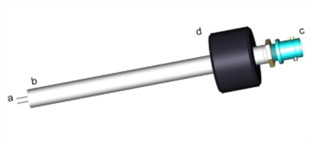
A ferrite core (d) is added to the setup to prevent a common mode voltage that is also present on the outer shield from interfering with the measured voltage at the connector (c). The ferrite core acts as a balanced to unbalanced (balun) transformer. Touching (handling) the probe on the connector (c to d) side isolates the electric field measurement at the probe tip (a to b). The outer shield also prevents the external electric field from influencing the inner conductor from the section (b to d) so that only the exposed tip (a to b) takes part in the measurement.
Magnetic Field (H-Field) Loop Probes
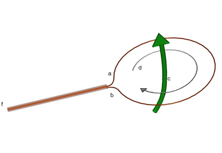
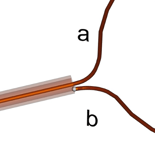
When the inner conductor (a) of a coaxial cable is wound into a closed loop and soldered to the outer shield (b) a magnetic field probe can be built. A changing magnetic field (c) inside the loop generates a current (d) (from Faraday's Law). So that a 50-ohm load, such as a spectrum analyzer or an oscilloscope, will detect a voltage proportional to the induced current, and of the magnetic field inside the loop.
The inner conductor is soldered to the outer shield to make a closed loop, the magnetic field generates a current flowing around the loop.
The configuration is sensitive to an external electric field and is commonly modified with the use of a split ring shield.
Split Ring Magnetic Loop Probe
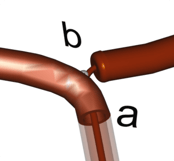
Using the external shield of the coaxial cable, a configuration similar to the magnetic field probe can be built that has the advantage of eliminating the effect of an external electric fields on the measurements. The coaxial cable (a) is formed into a loop and at the extreme end the inner conductor and outer shield (b) are brought together to close the loop.
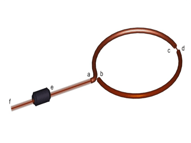
The loop has to have the outer shield cut (c and d) to prevent current from flowing along that path. The magnetic field is still present on the inner conductor and behaves the same way as the magnetic field loop probe to produce a voltage on an external instrument.
The ferrite core (e) serves the same purpose as in the electric field probe and suppresses common mode voltages on the surface of the external shield that would distort the measurement.
EMC Pre-Compliance Testing: Catching Problems Early
Every probe in this article is a pre-compliance tool. EMC pre-compliance testing means checking a product against its emission and immunity limits yourself, on your own platform, before booking time at a certified lab. It's not a substitute for formal certification but it's a way to catch problems early, while they're still cheap to fix.
With a near-field probe and a spectrum analyzer, you can localize an emission down to the offending component and test a shielding or ferrite fix on the spot.
Take Pre-Compliance Further with Averna
A dedicated RF test partner earns its place in order to notice early if your product has an EMI problem.
Averna develops and integrates RF and microwave test platforms across the full product lifecycle, from prototyping to high-throughput production. The same electromagnetic analysis and validation work that hardens a design against interference scales into the automated test systems that verify it in production. Explore our radio frequency testing expertise or get in touch with our RF experts.
You may also be interested in…
Did you miss the other parts of the Introduction to RF Shielding Blog Series? Go back to
> Part 1 - Basics of RF shielding
> Part 2 - Wiring and Signal Routing
> Part 3 - Ferrites
Get in touch with our experts or navigate through our resource center.


