
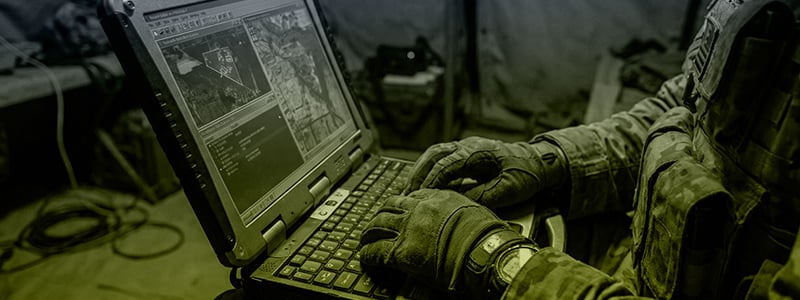
Imagine a mission-critical computer installed in a military helicopter. In flight, it is subjected to vibrations caused by the rotor and a rapid ascent into the cold atmosphere. On the ground, it sits on a flight line exposed to the sun, while the rotor's airflow blows fine sand into every connector. What tests can ensure that it will start up reliably before the next mission? What tests can prove that it will withstand all of this?
MIL-STD-810 is the answer to that kind of question. This U.S. Department of Defense standard starts from what the equipment will actually experience during its service life and turns that profile into a tailored set of laboratory tests.
Key Takeaways:
- MIL-STD-810 is not a checklist: programs select and tailor test methods based on the equipment's life cycle environmental profile.
- There is no MIL-STD-810 certification. A credible claim names the method, its revision and the procedure applied.
- MIL-STD-810H Change 1 (2022) is the current version. It keeps the same 29 methods as 810G but revises 19 of them.
What is the MIL-STD-810?
MIL-STD-810 is a U.S. Department of Defense test method standard titled Environmental Engineering Considerations and Laboratory Tests. It explains how to tailor environmental design and test requirements to the conditions equipment will face during its service life.
It provides 29 laboratory test methods, numbered 500 through 528. First issued in 1962, it has since gone through eight lettered revisions. The current text is MIL-STD-810H with Change Notice 1, dated May 18, 2022. It sits alongside other defense and aerospace testing standards.
Part One states plainly that the document does not impose design or test specifications, it defines an adaptation process. For our helicopter mission example above, nobody starts by asking which tests do we need to do? The first questions are where will the aircraft operate and how will the computer be stored and transported? The program team then selects and adjusts laboratory methods that replicate the effects of those environments rather than the environments themselves.
MIL-STD stands for Military Standard. Even if the standard 810 was originally written for defense applications, its foreword allows it to tailor to the commercial market. That explains why the same reference appears on rugged laptops and handheld devices as often as on military radios.
What Does MIL-STD-810 Test For?
The MIL-STD-810 standard is used to verify whether equipment can withstand the environmental stresses to which it is subjected throughout its life cycle. The test methods make up Part Two of the standard, between the tailoring guidance in Part One and the climatic data in Part Three. Each method targets a single stress or a deliberate combination of stresses. None of them are mandatory by default.
| Method | Name | What it checks |
|---|---|---|
| 500.6 | Low Pressure (Altitude) | Operation in low pressure and tolerance to rapid pressure changes |
| 501.7 | High Temperature | Performance and integrity under ambient or induced heat |
| 502.7 | Low Temperature | Performance and integrity in the cold, during storage, operation and handling |
| 503.7 | Temperature Shock | Resistance to air temperature changes greater than 10°C (18°F) within one minute |
| 504.3 | Contamination by Fluids | Effects of temporary exposure to contaminating liquids |
| 505.7 | Solar Radiation (Sunshine) | Heating effects and photodegradation from sunlight |
| 506.6 | Rain | Effectiveness of seals and covers, and performance during and after exposure |
| 507.6 | Humidity | Resistance to a warm, humid atmosphere |
| 508.8 | Fungus | Whether materials support fungal growth |
| 509.8 | Salt Fog / Corrosive Environments | Protection offered by coatings and finishes in salt-laden air |
| 510.7 | Sand and Dust | Susceptibility to blowing dust (under 150 µm) and blowing sand (150 to 850 µm) |
| 511.7 | Explosive Atmosphere | Operation in fuel-air atmospheres without ignition, or containment of an internal explosion |
| 512.6 | Immersion | Partial or complete immersion in water, such as fording |
| 513.8 | Acceleration | Steady inertia loads from platform maneuvers, and crash loads |
| 514.8 | Vibration | Vibration exposures across the life cycle |
| 515.8 | Acoustic Noise | Functional and structural resistance to severe acoustic environments |
| 516.8 | Shock | Shocks met during handling, transportation and service |
| 517.3 | Pyroshock | Shocks caused by pyrotechnic devices on the mounting structure |
| 518.2 | Acidic Atmosphere | Resistance to acidic atmospheres, for example near fuel-burning exhausts |
| 519.8 | Gunfire Shock | Shock and vibration from onboard gun firing |
| 520.5 | Combined Environments | Synergistic effects of temperature, altitude, humidity, input electrical power and vibration on airborne equipment |
| 521.4 | Icing/Freezing Rain | Effects of icing and effectiveness of de-icing |
| 522.2 | Ballistic Shock | Infrequent, high-level shocks from momentum exchange |
| 523.4 | Vibro-Acoustic/Temperature | Externally carried aircraft stores during captive carry flight |
| 524.1 | Freeze / Thaw | Moisture phase changes as temperature cycles through the freezing point |
| 525.2 | Time Waveform Replication | Reproduction of measured or specified field time traces |
| 526.2 | Rail Impact | Railcar impact conditions during transport |
| 527.2 | Multi-Exciter Test | Dynamic environments requiring more than one motion degree of freedom |
| 528.1 | Mechanical Vibrations of Shipboard Equipment | Vibration of equipment installed on Navy ships |
How to Read a Method Reference
Each method carries its own revision suffix. 501.7 is the seventh revision of Method 501, High Temperature. Many methods also hold several procedures. Method 510, for instance, separates Procedure I, Blowing Dust, from Procedure II, Blowing Sand. Since suffixes may vary, a reliable test report includes the complete reference. "Method 510.7, Procedure I" tells a reviewer far more than "dust tested to MIL-STD-810H."
How Do You Build a MIL-STD-810 Test Plan?
The MIL-STD-810 standard is very clear in its foreword:
It is important to emphasize that, with the exception of Method 528, these Methods are not to be called out in blanket fashion, nor applied as unalterable routines, but are to be selected and tailored to generate the most relevant test data possible. Methods 500 through 527 now contain the Note, "Tailoring is essential. Select methods, procedures and parameter levels based on the tailoring process described in Part One [...]"
In practice, there is no need to run all 29 test methods. The selection follows from the equipment's real use case: Where will it be stored, and how will it travel? Who will operate it, and in what conditions? Together, the answers form what the standard calls the Life Cycle Environmental Profile (LCEP).
The Life Cycle Environmental Profile (LCEP)
The LCEP gives a complete picture of the product over its service life. The standard specifies that an environmental engineering specialist prepares it, no later than the early part of the Technology Development phase. It follows the Environmental Engineering Management Plan (Task 401) and identifies the environmental conditions that apply to the equipment. Every event and condition count, between final factory acceptance and the end of the equipment's useful life, hence the term life cycle. For our helicopter computer, the biography includes months in a depot before deployment, then seasons on a desert flight line.
Each environment has to be characterized with real data, drawn from measurements on similar equipment wherever possible. The LCEP is also a shared effort: the customer supplies deployment areas and the concept of operations, while the supplier brings its engineering knowledge. An environmental engineering specialist pulls it together early in development, and every design and test decision builds on it.
Test Levels and Test Order
Once the methods are selected, the program still has to set test levels, ranges, rates and durations. The standard asks for these to be derived from data measured on identical or similar equipment, installed on comparable platforms. Only when such data is unavailable should the program fall back on the values proposed in each method.
For climatic conditions, Part Three provides the starting points. It groups world climates into climatic design types, each with its own daily cycles. These include:
- Hot (A1 and B3),
- Basic, cold (C2)
- Severe cold (C3),
Deployed to desert regions, our helicopter mission computer would draw its high temperature and solar radiation levels from the hot type rather than from a generic laboratory value.
Test order should follow the equipment's life. The standard recommends using the anticipated sequence of life cycle events as a guide, while acknowledging that in most cases no single sequence exists. It does, however, forbid altering a sequence simply to ease the effects of the tests.
The equipment's operating state matters too. Method 501.7 separates Procedure I, Storage, from Procedure II, Operation, and asks that storage come first when both apply. The mission computer must survive the parked aircraft unpowered, then work once the crew powers it up. The method also states that Method 520 is not a substitute for Method 501. A combined environment test complements individual tests rather than replacing them.
Is There a MIL-STD-810 Certification?
No. Government agencies or official bodies do not certify equipment to MIL-STD-810, and no certificate exists. Labels such as "MIL-STD-810 certified" or "military grade" describe tests that a manufacturer ran in-house or commissioned from a third-party laboratory. Their value depends entirely on which tests were run, and how.
What the standard does define is the evidence. Task 406, the Environmental Test Report, lists what a final report must document for each test. It covers the purpose of the test and the configuration of the test item. It records the parameters, durations, facility and procedure used. It also details how the item was operated during each test. The acquisition agency judges compliance from that report. Even a thorough report has limits. The standard specifies that laboratory test reports do not replace tests conducted in natural field environments.
What Are the Key Differences Between MIL-STD-810G and MIL-STD-810H?
MIL-STD-810H keeps the same 29 test methods as MIL-STD-810G Change 1 but revises 19 of them. The most noticeable change concerns Method 520, renamed Combined Environments, which now treats input electrical power as an environment in its own right. Change Notice 1, published in 2022, also renamed Method 509 as Salt Fog / Corrosive Environments.
A Short History of MIL-STD-810
MIL-STD-810 has been revised many times since 1962. Each edition shifted the balance a little further away from fixed test recipes and toward tailoring.
| Version | Date | What changed |
|---|---|---|
| MIL-STD-810 | 1962 | First edition of the standard. |
| MIL-STD-810A to 810C | 1964 to 1975 | Incremental updates. 810A and 810C largely carried over their predecessors. |
| MIL-STD-810D | 1983 | Places tailoring at the center of the standard and revises methods such as Humidity accordingly. |
| MIL-STD-810E | July 14, 1989 | Keeps the 810D content and adds a "How to Use MIL-STD-810E" flow diagram showing who prepares each document in the acquisition process. |
| MIL-STD-810F | January 1, 2000 | Major rewrite. Splits the standard into two parts, with Part One explaining how to implement tailoring across the acquisition cycle and an appendix describing the environmental engineering tasks. |
| MIL-STD-810G and Change 1 | October 31, 2008, and April 15, 2014 | Adds a third part, World Climatic Regions – Guidance. Change 1 requires that tailoring deviations be approved before testing starts and that their rationale be recorded in the test report. |
| MIL-STD-810H | January 31, 2019 | Supersedes 810G Change 1. Keeps the same 29 methods but revises 19 of them. Method 520 becomes Combined Environments and adds input electrical power. |
| MIL-STD-810H Change 1 | May 18, 2022 | Current version. Renames Method 509 as Salt Fog / Corrosive Environments. |
How Does MIL-STD-810 Compare With DO-160?
MIL-STD-810 and DO-160 both test electronics against environmental stress, but they come from different worlds. DO-160, Environmental Conditions and Test Procedures for Airborne Equipment, is published by RTCA for civil aviation, from airliners to emerging eVTOL aircraft, and serves as a reference for FAA approval. MIL-STD-810 serves defense applications and covers equipment in or on every type of platform, vehicles, ships...
DO-160 assigns equipment to predefined test categories, and a unit qualified at one category level is considered qualified for the less severe categories of the same test. MIL-STD-810 starts from the equipment's own life cycle profile and derives its tests from there.
| MIL-STD-810H | DO-160G | |
|---|---|---|
| Publisher | U.S. Department of Defense | RTCA, with EUROCAE publishing an identical twin, ED-14G |
| Scope | Defense equipment on any platform | Airborne equipment for civil aviation |
| Approach | Tailoring based on the LCEP | Predefined test categories |
| Power input and EMC | Outside its scope, covered by MIL-STD-704 and MIL-STD-461 | Included, with dedicated sections for power input and electromagnetic tests |
| Current version | 810H Change 1 (2022) | DO-160G (2010), with DO-160H in final review |
Equipment flying on both civil and military aircraft may have to satisfy both standards. The overlap is only partial, so a DO-160 test report rarely substitutes for an 810 program, or the reverse.
European Counterparts
In Europe, defense programs often reference NATO's STANAG 4370 alongside or instead of MIL-STD-810. It frames environmental testing through the AECTP series: AECTP-100 sets the guidelines, AECTP-200 the environmental conditions, AECTP-300 the climatic tests and AECTP-400 the mechanical tests. AECTP-500 covers electromagnetic environmental effects. In the UK, the Ministry of Defence relies on Def Stan 00-35, the Environmental Handbook for Defence Materiel. AECTP-200 cites both Def Stan 00-35 and MIL-STD-810 among its reference documents, a reminder that these standards evolved in dialogue.
Why Does Environmental Testing Matter Beyond Qualification?
Qualification is the visible milestone, but the value of environmental testing starts earlier. MIL-STD-810 describes laboratory test reports as an early warning system. They expose unexpected deviations from performance requirements while the design can still change, and they fuel failure analysis and corrective action. Planned early, design for testability also makes the product easier to monitor during those tests. A crack found on a vibration table during development will require an engineering change when found on a flight line.
Qualifying the Design, Screening Every Unit
A MIL-STD-810 program qualifies a design, usually on a handful of units. It does not guarantee that every unit leaving the production line is free of manufacturing defects. That is the role of environmental stress screening (ESS), which applies controlled stress to manufactured units to reveal latent defects before shipment. The two serve different questions: qualification asks whether the design can survive its life cycle, screening asks whether this particular unit was built right. The standard itself acknowledges the link, listing the equipment's configuration during ESS among the special considerations of the LCEP.
Upstream, HALT and HASS bridge both worlds. HALT pushes a design during development to find its operating and destruct limits. HASS then applies controlled stress levels in production as a screening method.
How Averna Powered by Spherea Supports MIL-STD-810 Programs
MIL-STD-810 rewards programs that treat testing as engineering rather than paperwork. The methods only produce useful evidence when the stress profile reflects the equipment's real life, and when the unit under test is monitored throughout.
Averna designs the aerospace and defense test solutions that make this possible. We cover environmental testing aligned with standards such as MIL-STD-810 and production screening. Planning a MIL-STD-810 campaign or a production screening strategy? Talk to our test engineering team.
You may also be interested in…
Averna delivers aerospace and defense test equipment and automated test systems to validate avionics, RF and microwave systems, radar, GNSS, satellite components, and control electronics while meeting strict certification requirements from development through production.
These aerospace and defense test solutions enable reliable, real-world validation for mission-critical systems in regulated programs. Check our brochure to learn more!


