

Verification and validation (V&V) are two of the most-confused terms in engineering, and the cost of confusing them lands squarely on the test bench. Teams that treat V&V as a single activity tend to discover the gap late. Usually when a product that passes every line on the test report still fails to do what the user actually needs.
In a test engineering context, the difference between the two is the difference between proving a measurement against a spec and proving a system against a mission, and each demands a different test architecture, instrumentation strategy, and acceptance approach.
Key Takeaways:
- Verification checks a system against its specification in a controlled environment with calibrated instruments. Validation confirms it meets real user needs in operational conditions.
- Verification comes first and feeds validation, but both trace back to the same requirements and skipping either one is where programs get into trouble.
- In a test engineering context, V&V is only as good as the test architecture behind it: instrumentation, fixturing, sequence design, measurement uncertainty, and traceability.
What are Verification and Validation?
Verification and validation are two distinct quality processes. Verification confirms that a system was built according to its specified requirements. Validation confirms that the system, as built, satisfies the actual need it was meant to serve. The V&V process is part of the V-model of systems engineering, transitioning from design to operations.
The cleanest way to recognize the difference is by asking two questions:
- Verification: is the product right? Does it match the specifications?
- Validation: is it the right product? Does it do what the user actually needs?
A system can be fully verified and still fail validation. If the requirements themselves were wrong, building them perfectly still does not solve the problem. That is the reason we need validation.
What's the Difference Between Verification and Validation?
Verification is internal and objective. It measures the system against documents the team already agreed on. Validation is external and tied to the user. It measures the system against the need, which often becomes clear only when real people use the system in real conditions.
Ultimately, verification checks against the specification and validation checks against the mission, which is rarely captured perfectly in writing. The implications go further than philosophy: the two processes call for different instruments, different data, and different acceptance criteria.
| Property | Verification (internal loop) | Validation (external loop) |
|---|---|---|
| Key question | Is the product right? | Is it the right product? |
| Goal | To meet requirements and specifications | To meet stakeholder expectations |
| Environment | Laboratory, controlled test system | Real or simulated mission environment |
| Focus | Components and subsystems | Complete system (full-up system) |
| Timeline | During development | During or after system integration |
| Instrumentation | Calibrated, traceable to a national standard | Often the deployed product itself, in its use environment |
| Acceptance criterion | Numeric limit with stated measurement uncertainty | Statistical or operational fitness-for-use |
| Data | Per-unit measurements against spec, logged for traceability | Field, clinical, or operational data, often population-level |
From Requirement to Result: V&V on the Test Bench
In a test engineering context, V&V is an end-to-end chain. A requirement is only verifiable if it has a method (analysis, inspection, demonstration, or test), an acceptance criterion, an instrument with sufficient resolution and traceable calibration, a place in a test sequence, and a record. Break any link, and the requirement becomes an opinion.
On a real bench, that chain looks like:
- Stimulus generation: signal source, load bank, environmental chamber, or whatever excites the DUT under controlled conditions.
- DUT interface: fixture, signal conditioning, isolation, and the often-underestimated mechanical interface that decides how reproducible the result will be.
- Data acquisition: bandwidth and resolution sized so that the measurement uncertainty is small relative to the tolerance being checked.
- Sequence and execution: a test executive that controls stimulus, dwell time, and order, while logging every measurement against a unique unit serial number and the test station's calibration state.
- Comparison and decision: a limit file with double-sided limits sized to the station's uncertainty budget, not just the design tolerance.
- Record: traceable measurement data tied back to the requirement and the unit, available for engineering, quality, and audit.
Validation runs a parallel chain. The same DUT is exercised in conditions that approximate real use, and its outputs are compared not to a spec but to a need. The two chains share requirements, but they rarely share equipment, environment, or acceptance criteria. Designing them as one architecture from the start, rather than two disconnected efforts, is one of the more reliable ways to avoid the late-stage surprises this article opened with.
Industry Examples to Catch the Difference
It's not always easy to tell the difference in V&V, but maybe these examples will help:
In Aerospace
Verification case: An airframe is loaded on a ground rig to 150% of its limit load, and engineers confirm the structure holds without failure. The check is against a written requirement, the 1.5 safety factor that civil airworthiness is built on, in a controlled setting with instrumented measurement. Strain gauges, load cells, and a calibrated control system make the result defensible. The structure either meets the specified strength, or it does not.
Validation case: The finished aircraft flies, and the operator confirms it achieves the range the route demands at the fuel burn the airline planned for, with handling that pilots accept in service. Flight test does double duty here, verifying documented capabilities for certification and validating that the aircraft meets the operational need. The same logic scales down to a drone program, where each unit is verified at end of line on an automated functional test station before anyone validates the platform in the field.
In Consumer Electronics
Verification case: A smartwatch's optical heart-rate sensor is measured on the test platform against a reference signal — typically a calibrated optical source in a controlled dark-box fixture — and confirmed to read within its specified accuracy. The display is checked against its luminance spec with a calibrated photometer. A camera module is confirmed to sit within its active alignment tolerance using a vision-system fixture. Each of these is a measurement against a spec, on a station whose own measurement uncertainty has been characterized.
Validation case: The same watch goes onto real wrists, across real activity and skin types, and its heart-rate reading is compared against a clinical reference to confirm it is trustworthy. A device can be perfectly accurate on the platform and still mislead in daily use, and that is a validation finding, not a verification one. It usually means the specification, while met, did not capture the real conditions of use — which puts the spec, not the product, on the to-fix list.
TL;DR: If you are checking against the spec, it is verification. If you are checking against the need, it is validation.
The Four Verification Methods
Systems engineering, as codified by INCOSE, recognizes four methods of verification. They sit on a rough scale of increasing rigor, and a single requirement is often verified by more than one of them.
- Analysis proves a requirement is met through calculation, modeling, or simulation. It is used when direct testing is impractical or too costly, as with thermal margins or structural loads.
- Inspection is the non-destructive examination of the artifact itself: visual inspection, measurement, and non-destructive inspection such as X-ray to catch a manufacturing defect. Inspection confirms an observable characteristic without operating the system.
- Demonstration means operating the system as intended to show it performs its function, without collecting detailed measurement data. It is qualitative. The alarm sounds, the door opens, the link connects.
- Test means stimulating the system with defined inputs and measuring the outputs against the requirement. This is the quantitative, instrumented method, and it is where most of the heavy lifting happens. Environmental testing, vibration, HALT and HASS, human-in-the-loop runs, they all live here.
The line between demonstration and test can be blurry. The discriminator is instrumentation. If you are recording measured data against a numeric requirement, it is a test. If you are showing that the function happens, it is a demonstration.
In practice, a defensible test result requires four things to line up: 1. a calibrated instrument with measurement uncertainty small relative to the tolerance; 2. a guard-banded limit derived from that uncertainty; 3. a sequence step that controls stimulus and dwell time so the result is repeatable; and 4. a record that ties the measurement to the unit's serial number and the test station's calibration state.
When any one of these is missing, a "Test" verification is a Demonstration with extra paperwork.
How does Validation Work?
Validation uses the same methods as verification but measures against the intended use in near-real conditions. We want the stakeholders to be satisfied with the delivery. In hardware and systems, it runs through four concepts:
- Qualification proves the design meets its requirements with margin, under levels that exceed normal operation. In test engineering practice, this is where HALT is used to discover destruct limits, and HASS screens are then derated from those limits to catch latent defects in production.
- Acceptance confirms each delivered unit conforms to the qualified baseline at production stress levels. Factory Acceptance Test (FAT), Site Acceptance Test (SAT), end-of-line (EOL) functional testing, and Environmental Stress Screening (ESS) all live here. At this stage, the focus shifts from "does the design work?" to "is this individual unit, on this line, within spec today?" which puts the test system's repeatability, uptime, and yield analytics in the spotlight.
- Certification is the formal recognition by an authority that the system meets its regulatory requirements.
- Approval for use is the final authorization to enter service.
Together they establish not just that the system was built right, but that it is fit and cleared for its purpose. They also impose a requirement on the test infrastructure itself: every measurement that supports a qualification claim, an acceptance decision, or a certification submission needs to be traceable to a calibrated instrument and a documented sequence.
How Verification and Validation Work Together in Test
Verification and validation actively work together because each catches a different class of error. Verify the wrong specification flawlessly, and you have built a perfect answer to a question nobody asked. Validate without first verifying, and you cannot tell whether a field problem is a design flaw, a manufacturing defect, or a measurement artifact.;
The most expensive failure mode in practice is not catching either error first, but rather it is the bench-to-line correlation gap. A unit passes verification on the engineering bench and fails the same test at the end of a production line, or it passes on the line and fails in the field. Nine times out of ten the answer is not a bad product but a difference in the approach to the test: the fixtures, instrument resolution, environmental envelope, or measurement uncertainty that was never explicitly budgeted.
Closing that gap is a test engineering problem, not a design problem, and it is one of the strongest arguments for treating V&V as a single architecture from the start: shared limit files, shared traceability schema, and an instrumentation strategy that survives the move from R&D to PVT to production.
Verification and Validation in Product Design and Development
In hardware product development, the same two questions map onto design verification and design validation. Design verification confirms that the design outputs meet the design inputs: the engineering requirements the team set for itself. Design validation confirms that the finished product meets the user's needs in its intended use environment.
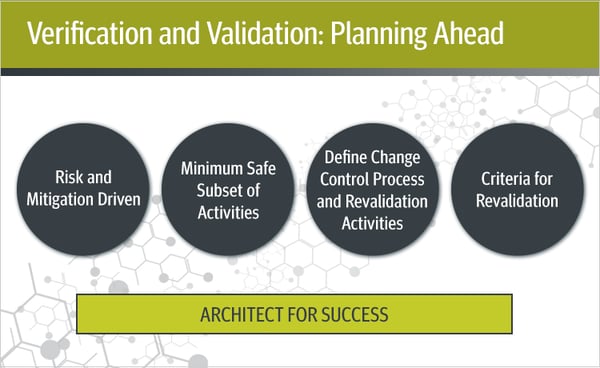
The lesson most teams learn the hard way is that validation problems found late are expensive, and they are expensive precisely because the test capability needed to find them earlier was never built. The cheapest way to avoid them is to test the theory early. A feasibility study or a proof of concept is, in effect, early validation. It is a check that the intended product is the right one before the specification is locked and the change orders build, and it is also a chance to scope the test architecture before it is forced into shape by a shipping deadline.
Requirements – Verification and Validation
Both processes are only as good as the requirements they trace to. Requirements verification checks that the requirements themselves are consistent and testable, with no ambiguity left to interpretation. Requirements validation checks that they actually capture what stakeholders need.
A practical testability check for any requirement is the five-point question:
- Does it have a verification method (analysis, inspection, demonstration, or test)?
- A defined acceptance criterion?
- An instrument with sufficient resolution and traceable calibration?
- An allocated step in a test sequence?
- A place in the traceability matrix that ties it to a record?
A requirement that fails any of those five is a requirement that will cause trouble later, which is one reason a disciplined specification phase pays for itself and why the requirements-to-test traceability matrix is one of the least glamorous and most valuable artifacts a program produces.
What is Independent Verification and Validation (IV&V)?
Independent verification and validation is V&V performed by a party organizationally separate from the development team. The independence is the key. A team that built a product carries assumptions about it, and an outside assessor is more likely to test what was actually delivered rather than what was intended. IV&V is common in aerospace and defense, and in other domains where the cost of a missed defect runs well beyond money. It is often required by standards such as IEEE 1012.
Independence applies to the test infrastructure as well as the activity. In regulated programs, the test system itself can require qualification, such as IQ/OQ/PQ on the hardware, and tool qualification on the test executive and any automation code that produces a verification result. The principle is the same: a verification claim is only as defensible as the instrument and the software that produced it.
A Note on Medical Devices
Medical devices deserve their own treatment, because there V&V is not just good practice but a regulated obligation. Under the FDA's design controls, design verification and design validation are defined activities with their own documentation requirements, and the framework is tightening as the Quality Management System Regulation takes effect.
For the regulated process itself, see how we cover the medical test validation process with an illustration of the GAMP 5-V model and how IQ OQ PQ protocols are involved.
How Averna Approaches Verification and Validation
Verification and validation only deliver value when the test architecture behind them is sound. That architecture needs to be calibrated, traceable, repeatable, and aligned to a requirements matrix that survives the move from R&D to production. Averna Powered by Spherea designs, builds, and deploys that infrastructure. This includes Design for Testability and feasibility work in early development, functional and end-of-line systems in production, and Gage R&R studies that prove measurement repeatability and reproducibility. It also includes qualified test executives and data platforms that close the loop on yield and traceability.
Test engineering teams typically engage us at one of three moments: when a specification is still moving and the test architecture needs to be deliberately flexible; when a bench that worked in R&D will not correlate to the production line; or when a regulated program like aerospace, defense, or medical, requires the test system itself to be qualified. If any of those describe where your program is right now, our engineers can help scope the next step.
You may also be interested in…
Verification and validation is an important step when building the right test solution. Find out more in our medical test expertise brochure.


